
CAPEX Procurement Strategy for Manufacturing Projects
Build a CAPEX procurement strategy that matches package risk and timing to the right market action, supplier engagement model, and cost-control discipline.
A good CAPEX procurement strategy is not just a list of packages and dates. It is the logic that decides which package needs early market testing, which one needs formal tendering, which item can be standardised, and which risk needs executive attention before money starts moving. If that logic is weak, the project pays for it later in change orders, slipped schedules, and bad comparisons.[1, 2]
Why this matters now
Manufacturing projects rarely fail because someone forgot to issue a purchase order. They fail because the sourcing plan did not match the maturity and risk profile of the project. A clean utility skid, a long-lead reactor, a commodity valve package, and a specialist automation scope should not all be sourced the same way.
The smarter play is to align package strategy with the quality of the definition, the timing pressure, and the supplier market. That is where cost engineering, project controls, and procurement need to act like one team rather than three separate functions.[1, 3]
Create and manage RFQs in minutes
ChemCapital handles the entire procurement cycle — from structured RFQs and supplier comparisons to formal purchase orders and delivery tracking.
Map packages by risk and timing
Start by splitting the project into sourcing packages that reflect commercial reality, not only the work breakdown structure.
Long-lead and highly customised items need early attention because they shape schedule risk.
Highly regulated or validation-sensitive packages need stronger supplier qualification and documentation expectations.
Repeatable or catalogue-like packages can often move later and more efficiently if specifications are standard.
The goal is not to create more packages than you need. The goal is to create better decisions. If one package has very different market conditions, engineering maturity, or supplier criticality from another, separate them early.
Use the right market engagement
Not every CAPEX package should go straight to formal tender.
Early concept packages may need supplier intelligence and budgetary input.
Feasibility packages may need option pricing and lead-time reality checks.
Budget-authorisation stage packages often benefit from structured quotation requests that capture assumptions and exclusions.
Mature, bid-ready packages should move into controlled RFQs with fixed response formats and pre-agreed evaluation criteria.[1]
flowchart LR
A[Concept scope] --> B[Market sounding]
B --> C[Feasibility options]
C --> D[Budget quotation]
D --> E[Formal RFQ]
E --> F[Award and PO]
This stage-appropriate approach keeps the market engaged without pretending every interaction is a final buying event.
Connect cost and procurement data
A CAPEX strategy gets stronger when budgeting and sourcing talk to each other continuously. When a package moves from early assumption to supplier-backed quotation, the project cost basis should be updated. When bidder exceptions reveal scope gaps, cost and schedule risk should be revisited. When long-lead realities change, the procurement plan and the estimate should move together.[2]
This is especially important because the technical baseline is not static. As the project definition improves, the sourcing plan should become less assumption-driven and more evidence-driven.
Practical example
A manufacturer planning a plant expansion identifies clean utilities, process vessels, automation, and installation services as key packages.
The wrong strategy is to tender everything when the drawings are half-ready.
The stronger strategy is to run early market engagement for the long-lead vessels, structured budget requests for utility and automation packages once the basis is stable enough, and formal RFQs for installation only when scope boundaries, interfaces, and site constraints are genuinely defined. That reduces rework and protects the critical path.
Connect package strategy to sourcing action
If your CAPEX team is still passing package strategy around in slide decks and spreadsheets, the workflow is too fragile. ChemCapital helps connect evolving project scope, supplier engagement, quotation evidence, and award logic in one flow. See how ChemCapital works or pair this with our guide to project costing.
Continue reading
Informational only, not procurement or legal advice. Cited names, frameworks, and statistics belong to their respective owners.
Create and manage RFQs in minutes
ChemCapital handles the entire procurement cycle — from structured RFQs and supplier comparisons to formal purchase orders and delivery tracking.
Start for freeRelated articles
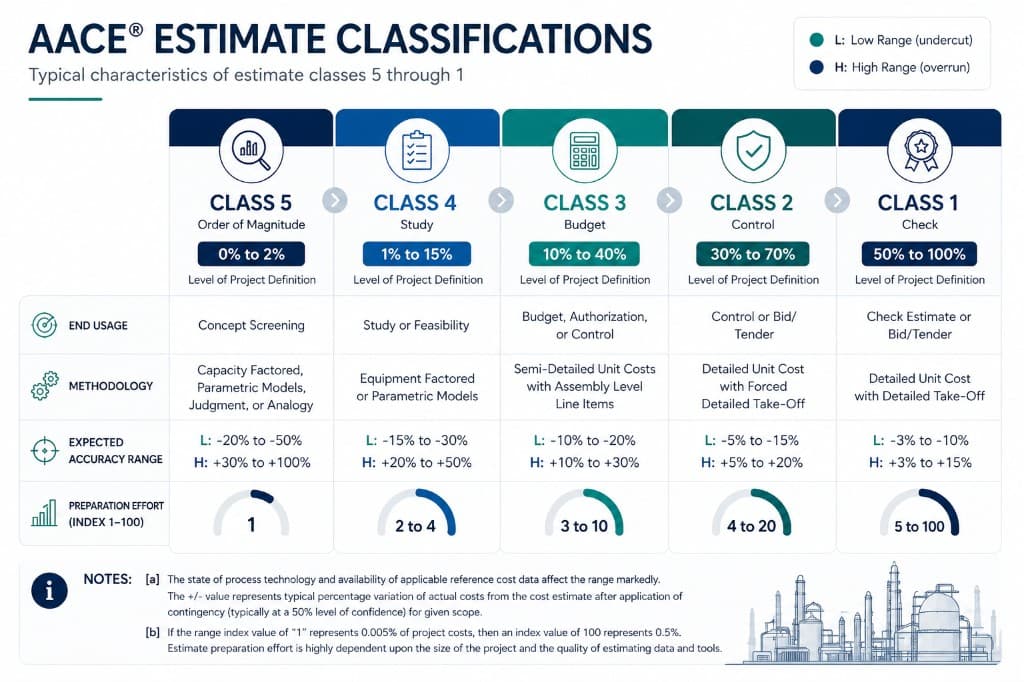
AACE Estimate Classes Explained for Procurement Teams
Learn how AACE estimate classes help procurement teams match supplier engagement to scope maturity, reduce rework, and run cleaner capital project sourcing.
How Industrial Suppliers Win More RFQs and Contracts
Industrial suppliers win more RFQs when they make evaluation easy: clear scope answers, strong evidence, credible delivery, and transparent commercial exceptions.
Procurement Digitisation Trends Industrial Teams Should Watch
The procurement digitisation trends that matter most for industrial teams: connected workflows, supplier data, AI with oversight, and comparable quotations.