
AACE Estimate Classes Explained for Procurement Teams
Learn how AACE estimate classes help procurement teams match supplier engagement to scope maturity, reduce rework, and run cleaner capital project sourcing.
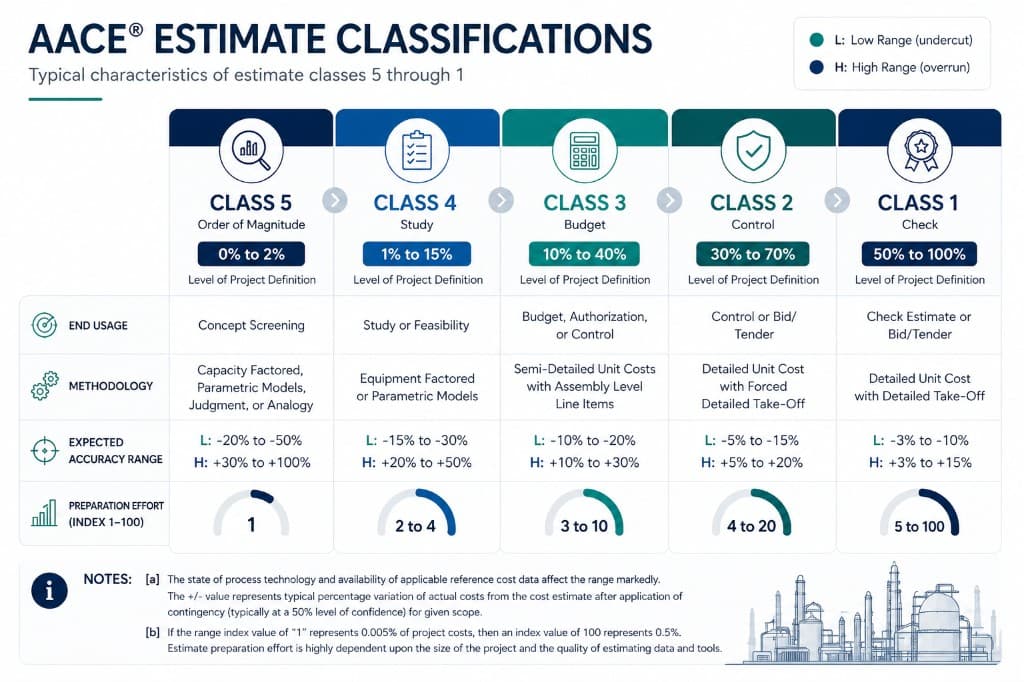
If you work on CAPEX, plant upgrades, or process equipment sourcing, one question matters more than most teams admit: is the scope mature enough for a real RFQ, or are you still gathering market intelligence? That is exactly where AACE estimate classes become useful. They give procurement, engineering, and suppliers a shared language for how developed the scope really is, and that stops everyone pretending a half-defined package is ready for a like-for-like commercial comparison.[1]
Why this matters now
A lot of procurement pain starts too early. The team wants budget confidence, a schedule pressure hits, and suppliers get asked for prices before the basis of design is stable. The result is predictable: assumptions multiply, qualification lists get longer, clarification rounds drag on, and the buyer ends up comparing numbers that were never based on the same thing in the first place.[1, 2]
For ChemCapital, this matters because estimate maturity should influence the workflow. Early-stage requests should look like structured market testing. Mature packages should look like formal RFQs with clear technical, commercial, and documentation rules.
Create and manage RFQs in minutes
ChemCapital handles the entire procurement cycle — from structured RFQs and supplier comparisons to formal purchase orders and delivery tracking.
The five estimate classes in plain English
The blunt version is simple. Early classes are for learning. Later classes are for buying.
- Class Five is concept stage. You are screening options, not locking suppliers.
- Class Four is feasibility. You can discuss approaches, long-lead realities, and rough commercial ranges.
- Class Three is usually the first sensible point for structured budget quotations.
- Class Two supports controlled tendering when the technical basis is materially developed.
- Class One is close to final definition and supports final bid checks, negotiations, and award decisions.[1]
The important detail is this: AACE says estimate class is determined primarily by the maturity of project definition deliverables, not by how polished the spreadsheet looks. In process industries, those deliverables often include PFDs, P&IDs, and electrical one-line drawings. That is why engineers and procurement should stop treating drawing maturity as a separate topic from sourcing readiness.[1]
How estimate class changes procurement behaviour
Procurement should not take the same market action at every class.
At low maturity, the goal is to test the market and expose uncertainty. Ask suppliers for assumptions, configuration options, risk notes, and indicative lead times. Do not force a false precision that nobody can defend later.
At mid maturity, the goal shifts to budget confidence. This is where structured supplier engagement becomes valuable. You can request commercial breakdowns, delivery windows, exclusions, warranty positions, and key documentation without pretending the package is already frozen.
At higher maturity, the goal becomes comparability and awardability. Now the RFQ should standardise response format, evaluation criteria, and evidence requirements so the team can compare scope compliance, total cost, schedule credibility, and commercial risk on one basis.[1, 2]
Why suppliers care about the class too
Good suppliers know the difference between a budget exercise and a bid-ready package. If the buyer signals estimate class clearly, the supplier can respond properly. At lower maturity, that means highlighting assumptions and confidence limits. At higher maturity, that means clean pricing, transparent exclusions, detailed lead times, and clear delivery commitments.
That clarity actually improves supplier relationships. It reduces the amount of guesswork hidden in quotes and lowers the chance that a later clarification turns into a pricing dispute.
Practical example
A pharmaceutical project team needs pricing for stainless steel process skids. The engineering basis is partly developed, but detailed instrumentation and a few utility tie-ins are still moving.
A weak approach is to issue a full tender and hope the market somehow aligns.
A stronger approach is to treat the package as a Class Three style budget request. Procurement sends a structured request that includes the current design basis, known constraints, open points, required documents, and a standard place for assumptions. Suppliers respond with budget pricing, delivery windows, and technical exclusions. By the time the package reaches formal tender maturity, most of the noise is already gone and the final RFQ is sharper, quicker, and easier to compare.
Put estimate maturity into the workflow
If your team is trying to connect project definition to sourcing discipline, do not leave estimate maturity trapped inside engineering files. Make it visible in the buying workflow. ChemCapital helps teams turn evolving scope into structured supplier engagement, then move cleanly from budget requests to formal RFQs and quote comparison. See how ChemCapital works or explore project costing.
Frequently asked questions
What does AACE stand for?
AACE stands for the Association for the Advancement of Cost Engineering, now commonly referred to as AACE International.
Which AACE class is best for an RFQ?
Class 3 can support structured budgetary supplier engagement, while Class 2 or Class 1 is better for formal competitive tendering.
Continue reading
Informational only, not procurement or legal advice. Cited names, frameworks, and statistics belong to their respective owners.
Create and manage RFQs in minutes
ChemCapital handles the entire procurement cycle — from structured RFQs and supplier comparisons to formal purchase orders and delivery tracking.
Start for freeRelated articles
CAPEX Procurement Strategy for Manufacturing Projects
Build a CAPEX procurement strategy that matches package risk and timing to the right market action, supplier engagement model, and cost-control discipline.
How Industrial Suppliers Win More RFQs and Contracts
Industrial suppliers win more RFQs when they make evaluation easy: clear scope answers, strong evidence, credible delivery, and transparent commercial exceptions.
Procurement Digitisation Trends Industrial Teams Should Watch
The procurement digitisation trends that matter most for industrial teams: connected workflows, supplier data, AI with oversight, and comparable quotations.